
Sales Development Strategies
Business Owner Sales Funnel Development, Prospecting & Referrals
A sales funnel is a concept that most smart salespeople and knowledgeable business owners understand very well, and it is essentially a visual marketing model that represents a customer’s journey from initial contact to the final sale.
As a business person, you likely understand the importance of marketing when it comes to the ongoing success of your business.
After all, without marketing, your business would eventually fail due to the absence of new customers.
Therefore, if you have not put enough time and effort into the marketing of your business thus far, now is the time to start, and one easy way to start is the utilization of a sales funnel.
Please see webland guide to average close ratios per industry over time; if your industry average 3% and you need 300 new customers a year how are you most efficiently and cost effectively getting your story, message and value proposition in front of 10,000 prospects?)
What is a Sales Funnel?
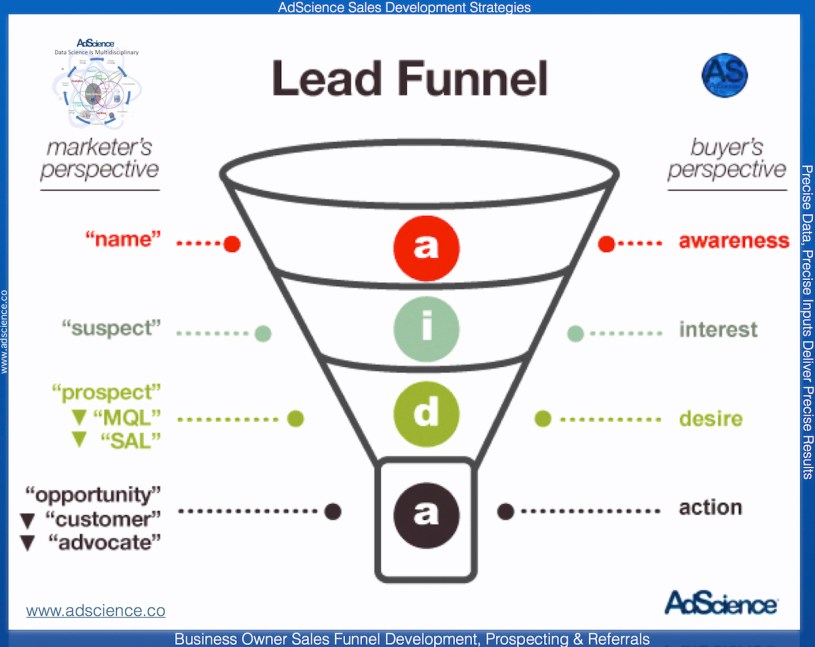
This strategy is so named due to the fact that when written out in diagram form, this particular marketing strategy looks like a funnel.
The top category is the biggest and it represents the largest amount of people, or potential customers. The bottom category represents the least amount of people, those who are committed customers, so it is much smaller.
Now that you know what a sales funnel is, you likely want a little more information pertaining to its implementation for your business.
After all, any strategy can seem great in theory, but you want to know how to actually go about building your own sales funnel.
Thankfully, the steps listed below will show you how to construct a type of sales funnel, perfect for a digitally advanced business.
-
Create a Great Landing Page
Your website’s landing page is the first impression all your potential customers will instantly have of your business.
Therefore, take time to make sure that it looks great. Also, a good landing page will encourage individuals to sign up for some sort of list, or subscribe to the website.
This in turn gives you the all-important contact information, which becomes your first line of communication.
-
Present a Main Offer
The next step in the funnel is to present potential customers with the opportunity to buy a product or procure your service. This is usually accomplished through the a sale’s page.
Be sure to showcase what your customers will get when doing business with you, mention all the benefits.
you should engineer with the additional mindset of… how will this help create more desire for the next up-sell offer I’m going to present them with next.
That strategy leads right into the next step.
-
Give an Up-sell
Offer your customers who just bought or are about to buy a product or service the opportunity to up-sell, or upgrade, that service.
For example, create an offer that will deliver even more benefit to the customer if they upgrade.
You are offering your customers more substance if they choose to upgrade.
Of course, that also means you make more money because an up-sell most often involves higher profit margin or higher priced product/service.
-
Offer an alternate Option
In the same way you encouraged customers to upgrade services in the up-sell step, this element of the funnel calls for you to offer a downgrade option to certain customers.
No, this isn’t a failure and should not be looked upon as a loss of a sale.
Instead, consider this a way to keep a customer that would not be able to buy from you at all due to budget constraints. Be considerate and offer cheaper options for those individuals and you can keep them as customers.
-
Keep it Going
The last step in the sales funnel is to keep your momentum going. Follow up with all the new customers you have acquired and ensure they are happy with their product or service.
A great way to accomplish this is to offer a membership-based rewards program. This will allow you to remain in contact with your customers, giving you the perfect way to tell them about new deals and services.
The steps listed above are geared to a business with an online presence. Of course, this might not describe your particular business.
Funnel modelling offline business
Elements of understanding your business and your customers and the funnel development process:
Focus your sales funnel management on what ‘they’ want (i.e., The Sales) instead of what the customer wants or needs (i.e. Results). Effective sales are about asking the right questions to the right people.
Business and Sales Managers need to ask good questions of their salespeople, and salespeople need to be comfortable asking what might appear to be tough questions of customers. It’s also important remember that how you ask the question is as important as what you ask.
Here are 4 questions business and salespeople should know for each of their customers. Do this, and you’ll have a clear sense of which pursuits are real, and which ones are a waste of time. Each question should be answered in the customer’s words.
-
What Happens if They Don’t Solve It?
Top sales performers always know the answer to this question and uncover this information from the customer early in the process. If the customer’s answer is insignificant to their business, then your sale probably won’t happen. Ultimately, you have to not only know the Issue, but also the Impact and associated Importance.
-
Who Else is Impacted? Are They Involved?
If you ask your customer, “Who is the decision maker?” You’ll always get the same answer: “I am!”
Perhaps ask your customer “Who else is impacted?” The people most directly impacted by solving the customer’s problem need to be involved early in the sales process.
-
Why Would We Lose This Deal?
Know why you would lose each opportunity. If the customer tells you it was about price, that means they felt they were getting better value from someone else. You can deliver better value without being the low bidder. Price matters most when the person selling believes price matters most.
-
Why would your customer change from what they are doing to what you are selling?
The single greatest competition is the status quo. Build a list of every reason why a customer would change from their existing vendor or solution to you. Then you can ask great questions to see if those conditions exist.
Prospecting
Prospecting is one of the most effective ways to beef up your sales pipeline, ensure sales continue to flow and improve your bottom line. Unfortunately, prospecting can be a sales professional’s biggest nightmare.
Sales professionals usually avoid prospecting for two different reasons: they are too focused on short-term results, and they see limited immediate results from their prospecting efforts.
The good news is that with a little guidance and some new techniques, your prospecting efforts can improve and so will the results of this effort. (see webland guide to sales coaches)
Here are tips that will drastically improve your prospecting strategy and will transform your job to a profitable career:
-
Prospect Before You Need To Prospect
One of the biggest mistakes a sales professional can make is to prospect only when sales are slow. Prospecting before you need prospects is the only way to build and maintain a pipeline of prospects that you can tap into on a regular basis.
The strategy for becoming proactive at prospecting is to establish weekly goals and schedule the activities that need to be carried out in order to achieve these goals.
Webland knows the simple fact that the more time you invest in prospecting for new business the more likely it is that you will never experience a sales drought. Prospecting on the regular will help you avoid the sales peaks and valleys that numerous professionals experience.
-
Get Creative With Your Approach
Prospecting is essentially the act of initiating new business relationships that present new business opportunities. In order to be effective in this arena, you must not limit yourself to just one strategy only. There are many effective techniques and I encourage you to try all, or at least some, of them all the time.
In order to be successful at prospecting, you need to identify what works well for you and do that often, but not exclusively. Keep your prospecting toolbox full of variety. For example, if you are really talented at cold calls, you should do that often. But that doesn’t mean that you should abandon tactics like email marketing, networking, direct mail, or referrals.
-
Nurture Your Relationships
These strategies don’t guarantee that each interaction with a prospect will result in a sale, rather, they guarantee that you’ll never find yourself without a prospect, without an opportunity, scrounging desperately for a quick sale to help you make your rent this month.
The key to nurturing relationships is to be consistent when you approach clients and make your interactions part of a longer-term plan for business success, rather than a one-off sale. Consistency means that prospects hear from you on a regular basis, not just when you need them.
Some of the best relationships and the biggest deals take the longest time to win. Show your prospects that you’re not only interested in working with them, but that you are dedicated to their needs.
Nurturing relationships is best executed with a plan. How often will you call your prospects? How often will they receive something from you? What will they receive? How can you offer them value at each touch point?
-
Take a Soft Touch Approach Power of PR
Through all your efforts to nurture and execute your prospecting strategy, keep in mind that prospecting isn’t about selling to strangers. Prospecting is about planting seeds and educating potential clients about who you are and what value you can offer to them. It’s also about information gathering. You should be spending just as much effort, if not more, trying to learn about them. What are their interests? What are obvious pains that you can help relieve? It’s all about soft-touches that open up opportunities for follow-up conversations and sales efforts.
-
Develop & Refine Your Value Proposition (see webland guide to defining your value proposition)
Why should your prospects return your call, respond to your email or take a meeting with you? What is it about you that makes your prospect act?
If you can’t answer this question right away – and confidently – than you should dive deeper into your sales strategy and further develop your value proposition. Your value proposition needs to clearly identify how you can help your prospect solve an issue or problem.
-
Measure. Measure. Measure.
It’s important to track your results and evaluate your efforts. If you don’t know exactly what is working and what isn’t, and why, then how will you be able to make a positive change?
Try tracking your progress for a few months so that you will have a benchmark to set future goals against.
(see list of webland sales measurement tools)
There are literally dozens of awesome CRM tools available today to help you develop a better sales funnel and prospecting program see webland guide to CRM’s here:
Referrals The Golden Goose;;
While most professionals recognize this, they don’t know how to tap into their networks to proactively generate sales referrals.
This happens for a number of reasons. Many sellers are uncomfortable asking for referrals. They either don’t want to appear “salesy” or desperate for the work. Or it might be insecurity—they’re not sure if they actually deliver value and benefit to their clients.
That’s why we put together this list of tactical tips for generating more referrals. But before you get started, make sure you’re doing the following:
Be referable. To make referral marketing a proactive part of your lead generation activities, you need to actually be referable. Ensure that you deliver what you promise, when you promise. Your clients need to be able to speak to the value you provide. (please see webland guide for defining value proposition)
Don’t rely on accidental referrals. It’s important to get clear on who you want to attract as clients and how your network can help you get referrals to those clients.
Don’t wait for the pipeline to dry up. Put a sales referral process into place now to drive high quality referrals consistently so that you’re not left scrambling when the pipeline stops flowing.
Here are 15 ways to get more sales referrals in no particular order:
Create a referral program with complementary providers to exchange referrals. Be sure you only include providers in this network that you’d be comfortable recommending to your best client or best friend.
Recognize and thank your referral sources. This could be with a simple phone call, email, or even better, a handwritten note. The important thing is to express your appreciation. You’ll also encourage additional referrals this way.
If you have clients who don’t refer, create another way for them to recommend you (e.g., case study, testimonial). I once worked for a large organization that prohibited written testimonials and discouraged referrals; however, I was able to provide recommendations by phone for vendors with which I worked. Two vendors I worked with took advantage of this opportunity and closed several deals by having select high-value prospects speak with me.
Make sure your current clients know about all the products and services you offer and how you help so they can either refer within their company or to others they know. Too often sellers assume their clients know more about them than they do. If you’re a market research firm and a client uses only your online survey research services, for example, make sure they know about your intercept interview service or focus group capabilities.
Add a link to a form on your website for referral submissions.
Be remarkable; remind clients why your company is special. Give them something (good) to talk about.
Inspire confidence. It’s risky referring someone—what if it’s not successful? You can inspire confidence in your referral sources by letting them know that 80% (or whatever) of your business comes from repeat customers.
Provide valuable content your referral sources can share with their network—an invitation to a breakfast or lunch seminar or webinar on an industry topic, research briefs, an article about a regulatory change or industry trend, etc. Make it something special for them to share.
Treat the vendors and suppliers with which you do business as partners. Make sure they’re aware of who and how you help.
Update your LinkedIn profile and stay engaged with your contacts regularly.
Create a list of buyers you want to work with. Check out their LinkedIn profiles to see whether you’re connected in any way. If so, reach out to them via your network—whether it’s an individual, a company, or a group.
Treat your clients as partners, too. Let them know you view them as a strategic partner, and tell them you hope they’ll do the same with you. Create formal channels to share referrals.
Give a referral. It’s one of the best ways to get one in return.
Ask for referrals. You’ll get a lot more referrals if you ask for them. As you’re completing a project with a client, simply ask if they know anyone who would benefit from something similar.
This is just a start. Let these suggestions jump-start your own idea generation. Create a sales referral process that works for your ideal clients and your networks.
Be referable. Focus on your ideal clients. Tap into your networks in a proactive way. By putting a referral system into place now, you are more likely to receive lead-boosting referrals throughout the year.
 Calibrate Ai