
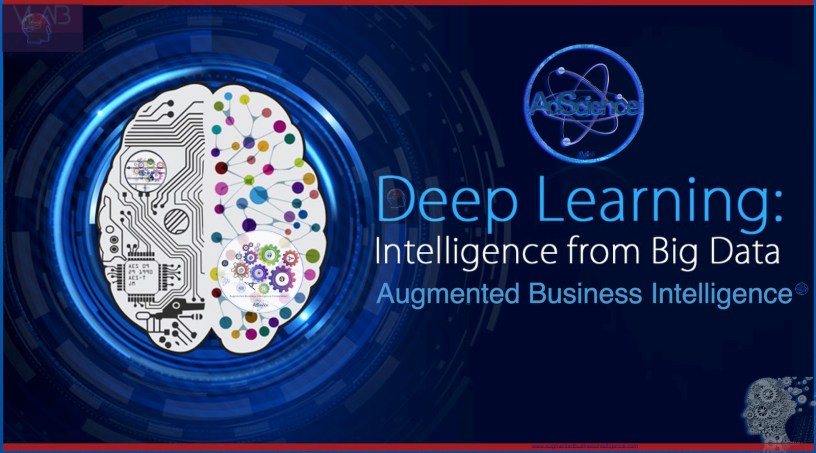
Deep learning (also known as deep structured learning, hierarchical learning or deep machine learning) is a branch of machine learning based on a set of algorithms that attempt to model high level abstractions in data.
At ABI AdScience and CalibrateAi deep learning (also known as deep structured learning, hierarchical learning or deep machine learning) is a branch of machine learning based on a set of algorithms that attempt to model high level abstractions in data specifically about the performance of advertising and marketing performance from all mediums for all products and services. At AdScience Augmented Business Intelligence and CalibrateAi Deep Learning is the essence of our platforms and tools. In a simple case, amongst your Glial cells you could have two sets of neurons: ones that receive an input signal and ones that send an output signal. When the input layer receives an input it passes on a modified version of the input to the next layer. In a deep network, there are many layers between the input and output (and the layers are not made of neurons {perhaps glia} but it can help to think of it that way), allowing the algorithm to use multiple processing layers, composed of multiple linear and non-linear transformations.
ABI Augmented Advertising Intelligence Deep Learning is part of a broader family of machine learning methods based on learning representations of data. An observation (e.g., an image) can be represented in many ways such as a vector of intensity values per pixel, or in a more abstract way as a set of edges, regions of particular shape, etc. Some representations are better than others at simplifying the learning task (e.g., product recognition or brand expression recognition). One of the promises of deep learning is replacing handcrafted features with efficient algorithms for unsupervised or semi-supervised feature learning and hierarchical feature extraction.
Our research in this area attempts to make better representations and create models to learn these representations from large-scale unlabeled data. Some of the representations are inspired by advances in neuroscience and are loosely based on interpretation of information processing and communication patterns in a nervous system, such as neural coding which attempts to define a relationship between various stimuli and associated neuronal responses in the brain. At ABI we endeavour to capture as much business intelligence as possible through our advertising investment surveys, calculators and dashboard to expand the clarity of advertising solutions and marketing programs for our participants.
 Various deep learning architectures such as deep neural networks, convolutional deep neural networks, deep belief networks and recurrent neural networks have been applied to fields like computer vision, automatic speech recognition, natural language processing, audio recognition and bioinformatics where they have been shown to produce state-of-the-art results on various tasks.
Definitions
There are a number of ways that the field of deep learning has been characterized. Recently, deep learning has been characterized as a class of machine learning algorithms that use a cascade of many layers of nonlinear processing units for feature extraction and transformation. Each successive layer uses the output from the previous layer as input. The algorithms may be supervised or unsupervised and applications include pattern analysis (unsupervised) and classification (supervised).are based on the (unsupervised) learning of multiple levels of features or representations of the data. Higher level features are derived from lower level features to form a hierarchical representation are part of the broader machine learning field of learning representations of data.learn multiple levels of representations that correspond to different levels of abstraction; the levels form a hierarchy of concepts. These definitions have in common multiple layers of nonlinear processing units and the supervised or unsupervised learning of feature representations in each layer, with the layers forming a hierarchy from low-level to high-level features. The composition of a layer of nonlinear processing units used in a deep learning algorithm depends on the problem to be solved. Layers that have been used in deep learning include hidden layers of an artificial neural network and sets of complicated propositional formulas. At AdScience, CalibrateAi & ABI we endeavour to capture as much business intelligence as possible through our advertising investment surveys, calculators and dashboard to expand the clarity of advertising solutions and marketing programs for our participants. They may also include latent variables organized layer-wise in deep generative models such as the nodes in Deep Belief Networks and Deep Boltzmann Machines.
ABI deep learning algorithms transform their inputs through more layers than shallow learning algorithms. At each layer, the signal is transformed by a processing unit, like an artificial neuron, whose parameters are ‘learned’ through training. A chain of transformations from input to output is a credit assignment path (CAP). CAPs describe potentially causal connections between input and output and may vary in length – for a feedforward neural network, the depth of the CAPs (thus of the network) is the number of hidden layers plus one (as the output layer is also parameterized), but for recurrent neural networks, in which a signal may propagate through a layer more than once, the CAP is potentially unlimited in length. There is no universally agreed upon threshold of depth dividing shallow learning from deep learning, but most researchers in the field agree that deep learning has multiple nonlinear layers. more visit www.adscience.co

ABI Fundamental Concepts
Deep learning algorithms are based on distributed representations. The underlying assumption behind distributed representations is that observed data are generated by the interactions of factors organized in layers. Deep learning adds the assumption that these layers of factors correspond to levels of abstraction or composition. Varying numbers of layers and layer sizes can be used to provide different amounts of abstraction.
Deep learning exploits this idea of hierarchical explanatory factors where higher level, more abstract concepts are learned from the lower level ones. These architectures are often constructed with a greedy layer-by-layer method. Deep learning helps to disentangle these abstractions and pick out which features are useful for learning. At ABI we uncover truths about effective mediums for business professionals and individual products on a geographic level.
For supervised learning tasks, deep learning methods obviate feature engineering, by translating the data into compact intermediate representations akin to principal components, and derive layered structures which remove redundancy in representation.
Many deep learning algorithms are applied to unsupervised learning tasks. This is an important benefit because unlabeled data are usually more abundant than labeled data. Examples of deep structures that can be trained in an unsupervised manner are neural history compressors and deep belief networks.
Neural networks (also referred to as connectionist systems) are a computational approach which is based on a large collection of neural units loosely modelling the way a biological brain solves problems with large clusters of biological neurons connected by axons. Each neural unit is connected with many others, and links can be enforcing or inhibitory in their effect on the activation state of connected neural units. Each individual neural unit may have a summation function which combines the values of all its inputs together. There may be a threshold function or limiting function on each connection and on the unit itself such that it must surpass it before it can propagate to other neurons. These systems are self-learning and trained rather than explicitly programmed and excel in areas where the solution or feature detection is difficult to express in a traditional computer program.
AdScience & CalibrateAi represented as neural networks typically consist of multiple layers or a cube design, and the signal path traverses from front to back. Back propagation is where the forward stimulation is used to reset weights on the “front” neural units and this is sometimes done in combination with training where the correct result is known. More modern networks are a bit more free flowing in terms of stimulation and inhibition with connections interacting in a much more chaotic and complex fashion. Dynamic neural networks are the most advanced in that they dynamically can, based on rules, form new connections and even new neural units while disabling others.
The goal of the neural network is to solve problems in the same way that the human brain would, although several neural networks are much more abstract. ABI AdScience neural network projects typically work with a few thousand to a few million neural units and millions of connections, which is still several orders of magnitude less complex than the human brain and closer to the computing power of a worm. As Augmented Business Intelligence continues to evolve our AdScience and CalibrateAi platforms and tools to enhance our data deliverable to our participating business we will endeavour to replicate human glial and neuron interaction.
For more detailed information about Augmented Business Intelligence Corporation please visit www.adscience.co www.augmentedbusinessintelligence.com https://calibrate.tech.blog/ www.augmentedadvertisingintelligence.com http://www.webland,ca http://www.calibrateai.com
MWS
 Calibrate Ai