
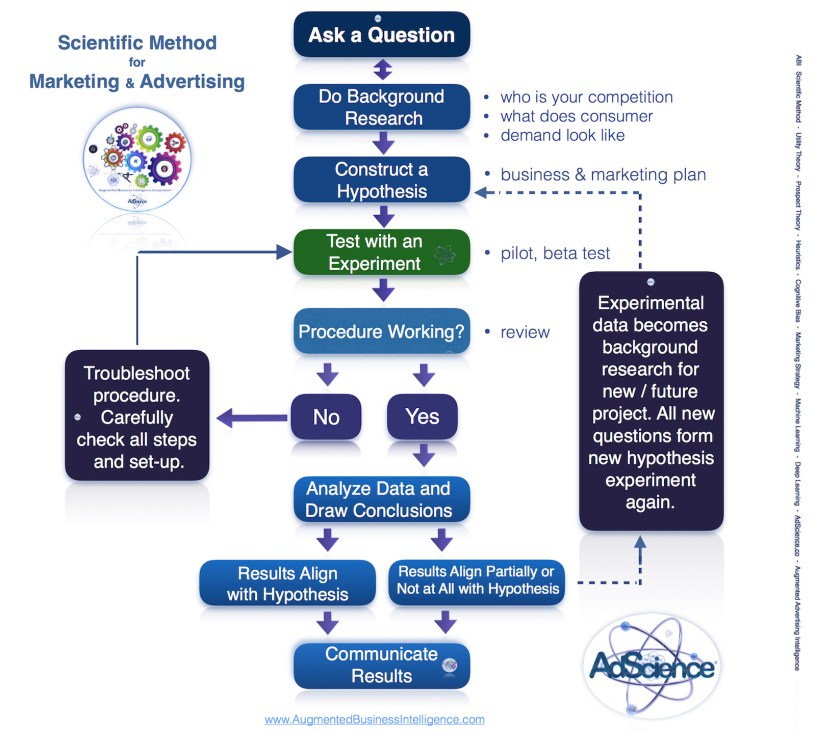
What is the Scientific Method?
The scientific method is a process for experimentation that is used to explore observations and answer questions. Does this mean all scientists follow exactly this process? No. Some areas of science can be more easily tested than others. For example, ABI data scientists studying how flyers engage consumers in a market previously untested by flyer distribution cannot fast-forward a campaign life by a few months years or run regressions on the sales until after they occur, but they can forecast and develop models based on comps. When direct experimentation is not possible, our scientists modify the scientific method. In fact, there are probably as many versions of the scientific method as there are scientists! But even when modified, the goal remains the same: to discover cause and effect relationships by asking questions, carefully gathering and examining the evidence, and seeing if all the available information can be combined in to a logical answer.
In business today we have access to unparalleled amounts of data, as a result we can now impose the scientific method (or process) in ways that were unimaginable only a few years ago. At ABI with our machine learning and deep learning process we endeavour to identify new insights daily on the most effective and efficient mediums for advertising and marketing based on both validated data from our community and evidence collected from hundreds and thousands of additional sources. For any business person who is interested in growing their customer base, finding and acquiring the best customers who best fit their product and or service offering we have the answers.
Even though we show the scientific method as a series of steps, keep in mind that new information or thinking might cause a scientist to back up and repeat steps at any point during the process. A process like the scientific method that involves such backing up and repeating is called an iterative process. At AdScience our iterative process is the core of our approach.
At ABI we will help you focus your scientific question and work through your observations and data to answer the question as well as possible.

Utility Theory @ AdScience
A theory used in economics that holds the belief that an item or service’s utility is a measure of the satisfaction that the consumer will derive from the consumption of that particular good or service. At Augmented Business Intelligence we place Utility Theory at the core of our approach, the most efficient way to find and target customers who most value your product and service. We build utility theory models into our dashboard to help business owners plan better marketing outcomes.
MCC Utility Theory as an economics concept that although it is impossible to measure the utility derived from a good or service, it is usually possible to rank the alternatives in their order of preference to the consumer. Since this choice is constrained by the price and the income of the consumer, the rational consumer will not spend money on an additional unit of good or service unless its marginal utility is at least equal to or greater than that of a unit of another good or service. Therefore, the price of a good or service is related to its marginal utility and the consumer will rank his or preferences accordingly.
 Prospect Theory
Prospect theory is a behavioural economic theory that describes the way people choose between probabilistic alternatives that involve risk, where the probabilities of outcomes are known. At ABI we understand the psychology behind consumers behaviour impacts not only their purchase motivations but also their level of satisfaction derived from owning the product or service. ‘think of an Apple Corporation obsessed consumer and their engagement with their iPhone, or an ABI customer using our AdScience platform to plan marketing campaigns.’
What is the ‘Prospect Theory
Prospect theory assumes that losses and gains are valued differently, and thus individuals make decisions based on perceived gains instead of perceived losses. Also known as “loss-aversion” theory, the general concept is that if two choices are put before an individual, both equal, with one presented in terms of potential gains and the other in terms of possible losses, the former option will be chosen.
Behind Prospect Theory
Prospect theory belongs to the behavioural economic subgroup, describing how individuals make a choice between probabilistic alternatives where risk is involved and the probability of different outcomes is unknown.
Heuristic Technique (and Cognitive Bias)
Heuristics are strategies derived from experience with similar problems, using readily accessible, though loosely applicable, information to control problem solving in human beings, machines, and abstract issues.
The most fundamental heuristic is trial and error, which can be used in everything from matching nuts and bolts to finding the values of variables in algebra problems.
Heuristics, which are commonly defined as cognitive shortcuts or rules of thumb that simplify decisions, represent a process of substituting a difficult question with an easier one. Heuristics can also lead to cognitive biases. There are divisions regarding heuristics’ relation to bias and rationality. In the fast and frugal view, the application of heuristics (e.g. the recognition heuristic) is an economically, physiologically and ecologically rational strategy that makes best use of the limited information available to individuals. Furthermore, while heuristics such as affect, availability, and representativeness have a general purpose character, others developed in social and consumer psychology are more domain-specific, examples of which include brand name, price, and scarcity heuristics.
In computer science, artificial intelligence, and mathematical optimization, a heuristic is a technique designed for solving a problem more quickly when classic methods are too slow, or for finding an approximate solution when classic methods fail to find any exact solution.
Cognitive Bias
A cognitive bias refers to a systematic pattern of deviation from norm or rationality in judgment, whereby inferences about other people and situations may be drawn in an illogical fashion. Individuals create their own “subjective social reality” from their perception of the input. MWS
For more information on how we employ the Scientific Method or Process to enhance your business results please visit us at www.augmentedbusinessintelligence.com or www.adscience.co or www.calibrateai.com
Sell more stuff. Get insights for any advertising medium. Digital Email, Outdoor Radio, Print, Billboards Newspapers, Flyers Magazines, Social, TV Websites, Mobile. maximize investment impact.
We strive to enhance decision making in the advertising world. We measure every medium, industry and product, and work relentlessly to become the world standard for advertising measurement. ABI AdScience.

 Calibrate Ai