
Scientific Method and Empirical Evidence in Advertising your business @ valuo
Empirical evidence is information acquired by observation or experimentation. This data is recorded and analyzed by our algorithms our machine learning and our data scientists and is a central process as part of the ABI AdScience scientific method.
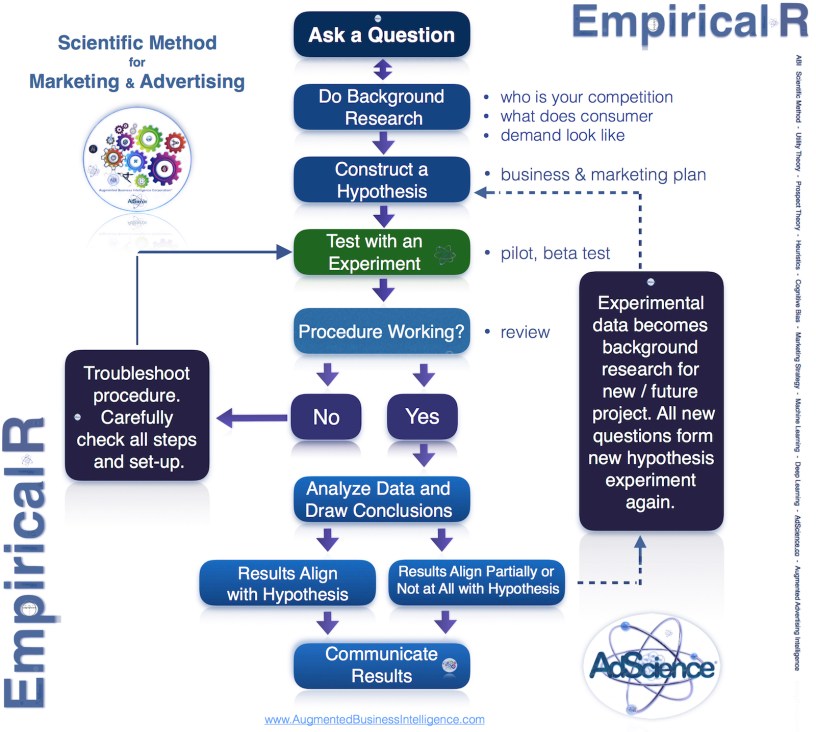
The scientific method @ ABI
The scientific method begins with our data scientists forming questions, or hypotheses, and then acquiring the knowledge to either support or disprove a specific theory (i.e., does advertising this particular product [product x] work in driving traffic [to business y in industry z]. That is where the collection of empirical data comes into play. Empirical research is the process of finding empirical evidence. Empirical data is the information that comes from the research.
Before any pieces of empirical data are collected, our data scientists carefully design their research methods to ensure the accuracy, quality and integrity of the data. If there are flaws in the way that empirical data is collected, the research and resulting evidence will not be considered valid.
The ABI scientific method often involves lab experiments that are repeated over and over, and these experiments result in quantitative data in the form of numbers and statistics. However, that is not the only process used for gathering information to support or refute a theory.
Types of empirical research
Empirical evidence includes measurements or data collected through direct observation or experimentation by our participating subscribing business and associations and our multiple sources of industry and trade data. There are two research methods used to gather empirical measurements and data: qualitative and quantitative.
Qualitative research, often used in the social sciences, examines the reasons behind human behaviour, there are numerous companies and SaaS services we work with who examine consumer and business behaviour and we gather their data along with our subscriber observation’s to identify consistencies and outliers. It involves data that can be found using the human senses. This type of research is done on an ongoing basis by our subscribers.
Quantitative research involves methods that are used to collect numerical data and analyze it using statistical methods. Quantitative numerical data can be any data that uses measurements, including mass, size or volume. This type of research is often used at the end of an experiment to refine and test the previous research, at ABI we utilize Quantitative data and research in real time on an ongoing basis where our algorithms update changes in effectiveness and related costs of various mediums.
An essential component of the ABI process is Identifying empirical evidence
Identifying empirical evidence in another data set or industry can sometimes be difficult. Some things we look for to determine if evidence is empirical:
Can the experiment or data be recreated and tested?
Does the data or experiment have a statement about the methodology, tools and controls used?
Is there a definition of the group or phenomena being studied?
Bias
The objective of science is that all empirical data that has been gathered through observation, experience and experimentation is without bias. The strength of any scientific research depends on the ability to gather and analyze empirical data in the most unbiased and controlled fashion possible.
The recording of empirical data is also crucial to the scientific method, as science [collective advertising data science] can only be advanced if data is shared and analyzed. Peer review of empirical data is essential to protect against bad science, this is the essence of the ABI platform.
ABI recognizes that cognitive bias inhibits growth in knowledge and growth in effective business practices, we look for evidence and situations where our data may be impaired by cognitive bias of the reporter of the data.
Empirical law vs. scientific law
Empirical laws and scientific laws are often the same thing. Laws are descriptions — often mathematical descriptions — in the business of ABI of both flaws in marketing approaches and opportunities. Empirical laws are scientific laws that can be proven or disproved using observations or experiments.
Learn more about how ABI and AdScience can help you grow your business today.

Empirical Research can be defined as research based on experimentation or observation (evidence). Such research is conducted to test a hypothesis.
The word empirical means information gained by experience, observation, or experiment. The central theme in scientific method is that all evidence must be empirical which means it is based on evidence. In scientific method the word “empirical” refers to the use of working hypothesis that can be tested using observation and experiment.
Augmented Business Intelligence Corporation and AdScience Technologies Platform and SaaS Advertising and marketing calculators and tools examines how different reasoning processes, positioning, experimenting, and enacting, drive business model innovation in entrepreneurial decisions and success. ABI builds on business model and entrepreneurial activity with advertising medium’s and their success and on a comparative studies of our subscribing associations, business and professionals. Our framework explains how types of knowledge mobilize as well as the different activities business utilize, in line with their reasoning processes, and how it influences their business model designs. The empirical findings suggest a new perspective on explaining how and why business marketing and advertising success occurs, highlighting the importance of cognition derived from the AdScience platform. www.augmentedbusinessintelligene.com
 Calibrate Ai