
CAC & LTV
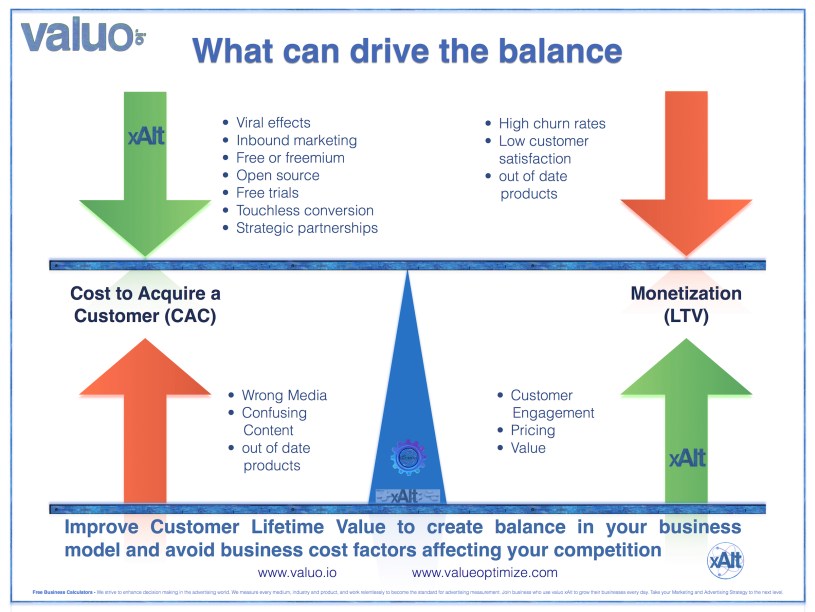
At valuo we like to help SME’s. Many firms have little idea how much it costs them to acquire new customers. They do some marketing, win some deals, and as long as the top line keeps going up — everything seems to be in order.
But what if your bottom line isn’t keeping up with revenue? What if your cost structure is out of whack or you’re paying more to acquire new customers than they’re worth?
Generating new business is critical, obviously — but it’s also critical to understand how much it’s costing you generate that business in relation to what it’s worth in the long run.valuo shows you what new business is really worth.
This may come as a surprise. But the two numbers that predict the future profitability and growth of your business have little to do with revenue, profit, or any of the traditional financial metrics you might be familiar with.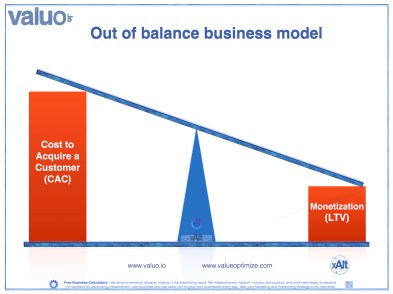
Customer Acquisition Cost (CAC) – How much does it cost, on average, to acquire new customers? Add up all the money you spend annually on marketing and sales (including salaries, advertising, event sponsorships, etc) and divide by the number of new deals you typically close in a year.
Lifetime Value (LTV) – How much is a new client worth? Most clients (hopefully) stick around beyond the first deal. How many deals do you usually get out of the average client? What are those deals typically worth? Remove expenses to come up with an average customer lifetime value.
These two numbers will tell you, in no uncertain terms, whether you’re making or losing money on new deals.
Winning Customers & Deals vs. Making Money
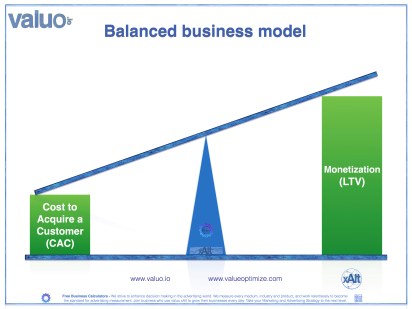
Acquisition costs and lifetime values have meaning on their own, but they are more meaningful and provide more insight when you compare them to each other by calculating your Lifetime Value (LTV) to Customer Acquisition Cost Ratio [LTV:CAC] — which is the relationship between how much you earn from a typical client and how much it costs to acquire that client.
As a rule of thumb: (these formulas are guidelines but not exact for all industries.)
- If LTV:CAC is less than 1 (i.e. your cost to acquire customers is higher than their lifetime value), it’s amazing you’re still in business. Either you’ve found a way to defy logic or you’re headed for a cliff.
- If LTV:CAC is roughly equal (1:1), it’s no wonder you’re scraping by. You’re just barely bringing in enough business to stay afloat. This is clearly not sustainable and you need to find ways to either increase LTV or decrease CAC.
- If LTV:CAC is 3:1, you’re right in the sweet spot. This is where profitability and growth are in perfect balance for most businesses. You’re making money, but you’re still investing in future growth at a reasonable rate. Keep doing what you’re doing.
- If LTV:CAC is 4:1 or higher, you might think you’re in good shape because each new deal is worth 4X the cost of acquisition. That’s an amazing profit margin. But it also means you should be reinvesting more of that profit on customer acquisition. In other words, you could be growing faster if you spent more.
Make or Break Metrics: Customer Acquisition Cost & Customer Lifetime Value
Create marketing strategies that work / Full Stack Marketing
Improve your marketing performance across multiple channels by getting exclusive access to our powerful retention metrics proven to boost conversions and reduce customer churn across all components of your business, in store, in the field, in your call centre, during customer service visits, in email, ads, mobile, and website. Here at valuo, our data science team spends a lot of time thinking deeply about customer retention for commercial businesses. Simply put, our highest priority is in your success. Get involved in high level predictive analytics and take part in winning strategies with valuo.

With valuo xAlt you will learn:
Measuring the accuracy of predicted Churn of your customers
Deeper understanding of the forecasted spend of your customers (Customer Future Value)
CFV validation reports, methods, applications
Customer Retention is hard. xAlt makes it easier.
 Calibrate Ai